
How Systems Thinking May Assist with Small Business Problems
A Possible Solution: Systems Thinking
Every entrepreneur knows the feeling of “business whack-a-mole.” You resolve an issue with client on boarding, only for communication delays to pop up in project delivery. You boost marketing efforts, only to overwhelm your team or yourself with fulfillment bottlenecks.
When you are constantly solving the same problems under different names, the issue isn’t your effort, it’s your framework. You cannot focus on growing a business if you are constantly managing the back office tasks.
This is where a potential solution called Systems Thinking, which is becoming more popular, can be of assistance.
What is Systems Thinking?
The short answer: it is the consideration of how components influence each other, building on those connections over time to create a flowing system. It may sound like double talk, but you have probably already been practicing this way of thinking in other areas of your life, if not in some areas of your business.
Point A connects to Point Z, which interconnects to Point B, etc. It can be a twisted mess, zigging and zagging through every area of business. I asked AI for a short answer and the chart came with it.
Gemini wrote: Systems thinking is a holistic framework for problem-solving and analysis that focuses on how individual parts within a system interact, influence one another, and function as an integrated whole over time.
Unlike traditional linear thinking (which breaks problems down into isolated components), systems thinking examines dynamic patterns, feedback loops, and root causes across complex organizational, biological, ecological, or social networks.
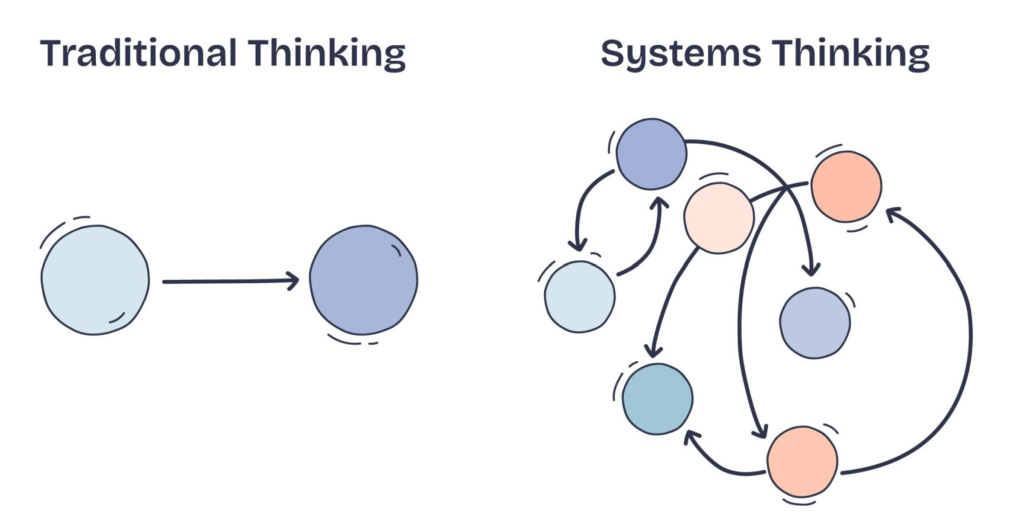
Beyond Linear Thinking
Most business owners are trained in linear thinking: Problem A leads to Cause B, so apply Fix C.
While this works for simple tasks, businesses are dynamic organisms. Actions do not occur in isolation. What was working yesterday is not necessarily going to work today. No two days are ever the same and each day brings a new challenge. As a small business owner you could benefit by creating a system that can adjust and assist in adapting to those unplanned changes. The short time you take to create and implement a system will save you time in the long term.
Systems thinking is the practice of stepping back from individual daily crises (the events) to observe the underlying structures, feedback loops, and operational habits that create those outcomes.
Following is an outline of the differences between linear and systems thinking.
Linear vs. Systems Thinking in Small Business
|
Challenge |
Linear Response (Symptom-Focused) |
Systems Response (Structure-Focused) |
|
Low Team Productivity |
Push employees to work harder or hire more staff immediately. |
Examine workflow handoffs, unclear instructions, or tool bottlenecks that slow tasks down. |
|
Inconsistent Cash Flow |
Run emergency discount sales to drive quick cash. |
Analyze payment cycles, invoicing delays, and client retention structures. |
|
Client Misunderstandings |
Blame the client for “not paying attention.” |
Refine the intake and expectations system during the initial on-boarding touch points |
The 3 Pillars of Every Business System
Whether you run a sole proprietorship, a consultancy, or are building a corporate structure, your business operates through three core elements:
1. Elements: The visible parts of your venture: your software tools, team members or yourself, deliverables, and communication channels.
2. Interconnections: The rules, workflows, and communication paths that tie those elements together (e.g., how a sales lead becomes a project task).
3. Purpose: The actual output or trajectory your current structure produces, which isn’t always what you intended. (If your process yields late deliverables, the current system is designed to yield late deliverables).
Understanding Feedback Loops and Delays
In business operations, actions bounce back. Systems thinkers pay close attention to two dynamics:
1. Feedback Loops
• Reinforcing Loops: Accelerate momentum. For instance, great client service leads to glowing reviews, which attract better clients, enabling higher rates. Conversely, poor communication leads to frantic inquiries, which waste time and cause poorer communication.
• Balancing Loops: Pull systems back toward equilibrium. If you take on too many projects, your delivery quality naturally dips, leading to lost clients until your workload settles back to what your current capacity can handle.
2. Delays and Lag Time
Changes in business rarely yield immediate results. If you pause marketing efforts today because you are busy with clients, you won’t feel the impact immediately. You will feel it two months from now when current contracts end and your pipeline is completely dry. Recognizing delays prevents knee-jerk decisions.
4 Practical Steps to Build a Systems-Driven Business
If you are launching or scaling a business, here is how you can begin thinking in systems starting today:
1. Map Your Workflows Visually: Draw out your client journey from initial awareness to final delivery. Where do tasks pile up? Where does information get lost?
2. Look for Root Structures, Not Blame: When a mistake happens, refrain from asking “Who messed up?” Instead, ask “What step or instruction in our process made that error easy to commit?”
3. Design for Frictionless Execution: Simplify client intake forms, create standardized templates, and automate repetitive handoffs so your creative energy stays focused on strategy.
4. Respect the Delay: Give operational adjustments time to show results before jumping to a new tool or strategy.
Transform Chaos into Streamlined Operations
At Office Wife LLC, I guide and assist those interested in starting and transforming their business. I will assist you in the transition to building a business rather than managing. Together we will build a structure that works for you, not against you.
Ready to optimize your business operations? Contact Office Wife LLC today to audit your systems.